Chem With Com = Chem For All!
Brief introduction: – This is a free complete Introductory Chemistry lecture course (C-ID CHEM 101 lecture portion only). I’m trying to do things a little different and my rationale is at bottom of this page. We’ll see how it works… Chemistry is just learning about how the universe works and shouldn’t really cost anything. I recommend going in order with all the videos but you can choose your own adventure by searching (CTRL+F) key words and choosing the appropriate topics. Although these topics and subtopics can be learned individually, it works best when completing the entire series of topics because I may leave more complicated things out initially, but then revisit them later when students have more understanding of certain things.
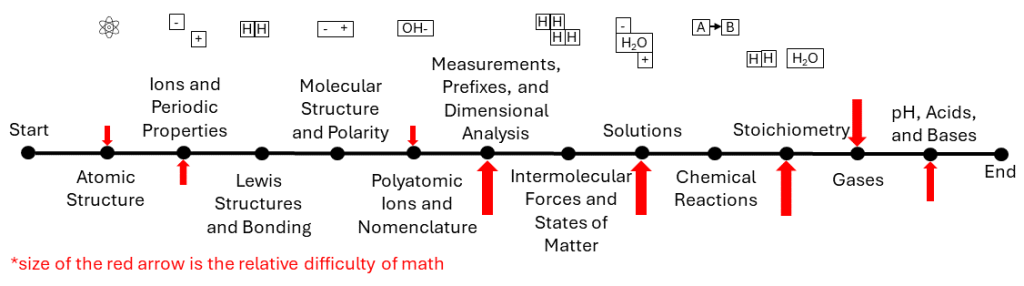
Below is an infographic showing the order of topics and places with relative math difficulty.
Here are Notetaking Slides and are non-informational slides for notetaking only
These are Accompanying Questions that I recommend you use while you watch the video lectures to direct what I think is important and will help you on the Take Home Quizzes.
Here are Take Home Quizzes that will help you assess your knowledge of the material.
I have adapted much of this material from OpenStax Chemistry Atoms First 2e
This is the lab manual I use for my in-person classes.
Topic/Video/Key Word Guide
| Topic | Subtopics | Video Link | Book Chapters | Key Words | Notes |
| Topic 01: Atomic Structure and Significant Figures | Lecture 1: Atomic Structure | https://youtu.be/6mKEqdIcSKY | • Chapter 2.3 (Atomic Structure and Symbolism) • Chapter 3.6 (The Periodic Table) | atomic structure,signficant figures,math and significant figures,isotopes,atomic mass | |
| Lecture 2: Isotopes and Significant Figures | https://youtu.be/wBxQxun3p8Q | • Chapter 2.3 (Atomic Structure and Symbolism) • Chapter 3.6 (The Periodic Table) • Chapter 1.5 (Significant Figures) | atomic structure,signficant figures,math and significant figures,isotopes,atomic mass,percent,order of operations | ||
| Lecture 3: Atomic Mass and Math and Significant Figures | https://youtu.be/l843ijnEOBk | • Chapter 2.3 (Atomic Structure and Symbolism) • Chapter 3.6 (The Periodic Table) • Chapter 1.5 (Significant Figures) | atomic structure,signficant figures,math and significant figures,isotopes,atomic mass,percent,order of operations | ERROR Correction: At 22:30, the number 55.8752 has 6 significant figures. | |
| Topic 02: Ions, Periodic Properties, and Moles | Lecture 1: Ions | https://youtu.be/Ocm_FZxmWLM | • Chapter 2.3 (Atomic Structure and Symbolism) • Chapter 3.6 (The Periodic Table) • Chapter 3.7 (Ionic and Molecular Compounds) | ions,periodic table,cations,anions, electrons,protons | |
| Lecture 2: Periodic Properties | https://youtu.be/DQyFNn-7oqE | • Chapter 2.3 (Atomic Structure and Symbolism) • Chapter 3.6 (The Periodic Table) • Chapter 3.7 (Ionic and Molecular Compounds) | ions,periodic table,cations,anions, electrons,protons,periodic properties | ||
| Lecture 3: Moles and Exponential Notation | https://youtu.be/BcUPmg2Dj7Q | • Chapter 2.4 (Chemical Formulas) • Appendix B (Essential Mathematics) | ions,periodic table,cations,anions,electrons, protons,periodic properties,moles,mol, exponential notation,scientific notation | ||
| Topic 03: Lewis Structures, Bonding, and Molecules | Lecture 1: Lewis Symbols, Octet Rule, and Ionic Bonds | https://youtu.be/W2QZcuSx07Q | • Chapter 4.4 (Lewis Symbols and Structures) • Chapter 3.6 (The Periodic Table) • Chapter 3.7 (Ionic and Molecular Compounds) | electrons,ionic bonding,ionic compounds,lewis symbols,octet rule,anions,cations,valence electrons,metals,nonmetals | |
| Lecture 2: Lewis Structures and Covalent Bonds | https://youtu.be/tVhAFU9KOEs | • Chapter 4.4 (Lewis Symbols and Structures) • Chapter 3.7 (Ionic and Molecular Compounds) | electrons,lewis symbols,octet rule,valence electrons,nonmetals,covalent compounds,molecular bonds | ||
| Lecture 3: Molecules, Compounds, and Chemical Formulas | https://youtu.be/YyIuCHkyzXM | • Chapter 2.4 (Chemical Formulas) • Chapter 3.6 (The Periodic Table) • Chapter 1.2 (Phases and Classifications of Matter) | molecules,compounds,ionic compounds,molecular elements,molecular compounds,molecular formula,empirical formula,chemical formula | ||
| Topic 04: Molecular Structure and Polarity | Lecture 1: Molecular Structure | https://youtu.be/wIU43qsFY8w | • Chapter 4.6 (Molecular Structure and Polarity) | VSEPR,Electron-Pair Geometry,Molecular Structure,Molecular Shapes,3D Molecules,Trigonal Planar,Tetrahedral,Trigonal Pyramid,Trigonal Pyramidal,Bent | |
| Lecture 2: Electronegativity and Polar Covalent Bonds | https://youtu.be/dOwY4S2GL9k | • Chapter 4.2 (Covalent Bonding) | VSEPR,electronegativity,polar bonds,polar covalent bonds | ||
| Lecture 3: Molecular Polarity and Dipole Moment | https://youtu.be/keMkk_X3cM4 | • Chapter 4.6 (Molecular Structure and Polarity) • Chapter 4.2 (Covalent Bonding) | VSEPR,Molecular Polarity,Dipole Moment,Polar Molecules,Polarity,delta | ||
| Topic 05: Polyatomic Ions and Nomenclature | Lecture 1: Polyatomic Ions and Neutral Compounds | https://youtu.be/mZzek4a0cpw | • Chapter 3.7 (Ionic and Molecular Compounds) | polyatomic ions,neutral compounds,nomenclature,fixed charge ions,variable charge ions | |
| Lecture 2: Nomenclature Info and Covalent Compounds | https://youtu.be/8uOrXnAcuBU | • Chapter 4.3 (Nomenclature) • Chapter 3.7 (Ionic and Molecular Compounds) | nomenclature,fixed charge ions,variable charge ions,nomenclature prefixes,hydrates,metals, nonmetals,polyatomic ions,molecular compounds,covalent compounds | ||
| Lecture 3: Nomenclature of Ionic Compounds and Acids | https://youtu.be/ncbThPi_6zs | • Chapter 4.3 (Nomenclature) • Chapter 3.7 (Ionic and Molecular Compounds) | nomenclature,fixed charge ions,variable charge ions,nomenclature prefixes,hydrates,metals, nonmetals,polyatomic ions,molecular compounds,covalent compounds,acids,neutral compounds | ||
| Topic 06: Measurements, Prefixes, and Dimensional Analysis | Lecture 1: Units, Measurements, and Density | https://youtu.be/YGpVEj6NCrg | • Chapter 1.4 (Measurements) • Chapter 1.5 (Measurement Uncertainty, Accuracy, and Precision) | SI units,length,mass, volume,mole,time,temperature, density,gram,kelvin,liters,kilograms, celsius | |
| Lecture 2: Prefixes and Exponential Notation | https://youtu.be/oz-d_ptnjbk | • Chapter 1.4 (Measurements) • Appendix B (Essential Mathematics) | SI units,length,mass,volume,moles, time, temperature,density,gram,kelvin,liters, kilogram,celsius,prefixes,exponential notation,kilo, mega,giga,micro,centi,milli,nano,pico,scientific calculator | Error at 8:11 on slide, top value should be 1357.0 not 13570 | |
| Lecture 3: Dimensional Analysis | https://youtu.be/lRVZGZ0ns_E | • Chapter 1.6 (Mathematical Treatment of Measurement Results) • Appendix C (Units and Conversion Factors) | dimensional analysis,conversion,gram,mole, scientific calculator,units,atom,molecule, part 1,unit | ERROR: at 41:24 I put 59.7/1.057 in the calculator and it should have been 59.7 x 1.057 = 63.103; with sigfigs it's 63.1qt. | |
| Lecture 4:Dimensional Analysis (grams to moles to units) | https://youtu.be/086n3n-ZnXM | • Chapter 2.4 (Chemical Formulas) | dimensional analysis,conversion,gram,mole, scientific calculator,units,atom,molecule, part 2,unit | ||
| Topic 07: Intermolecular Forces, States of Matter, and Energy | Lecture 1: Intermolecular Forces | https://youtu.be/1TbH4qb2jB0 (38:59) | • Chapter 10.1 (Intermolecular Forces) • Chapter 10.2 (Properties of Liquids) | physical states, intermolecular forces, IMF, Dispersion Forces, Dipole-dipole, London Forces, Hydrogen Bonds, H-Bonds, boiling points, viscosity, surface tension, meniscus, capillary action, capillary tube | |
| Lecture 2: States of Matter and Energy | https://youtu.be/aGUB5QxV2Mw (46:18) | • Chapter 10.3 (Phase Transitions) – heating and cooling curves only • Chapter 10.4 (Phase Diagrams) • Chapter 9.1 (Energy Basics) | energy, intermolecular forces, IMF, phase change, pressure, temperature, phase diagram, heating curve, cooling curve, exothermic, endothermic, specific heat, heat capacity | ||
| Topic 08: Solutions and Empirical Formula | Lecture 1: Mixtures | https://youtu.be/KOao3grdelU (11:03) | • Chapter 1.2 (Phases and Classifications of Matter) • Chapter 11.2 (Electrolytes) - how things mix - ion-dipoles • Chapter 11.3 (Solubility) – miscibility | mixture,homogenous,heterogenous, polar, nonpolar,miscible, immiscible,miscibility | |
| Lecture 2: Solutions | https://youtu.be/kOZbQergT4E (58:21) | • Chapter 6.3 (Molarity) • Chapter 6.4 (Other Units for Solution Concentrations) | solute,solvent,solution,mass percent,molarity, dilution, mole,liter,M1V1=M2V2,C1V1=C2V2, M1L1=M2L2,percentage, part,whole,percent composition, disslove,dissolving | ||
| Lecture 3: Percent Composition and Empirical Formula | https://youtu.be/FGVtQedreuA (34:37) | • Chapter 6.2 (Determining Empirical and Molecular Formulas) | empirical formula, molecular formula,gram to moles,percent composition,mole ratio | ||
| Topic 09: Chemical Equations and Chemical Reactions | Lecture 1: Chemical Equations and Balancing | https://youtu.be/h0VB-mbfI4E (34:40) | • Chapter 7.1 (Writing and Balancing Chemical Equations) | chemical equation,balancing,states of matter,ingredients,recipe,balanced equation, mole ratio,unbalanced equation, coefficient | |
| Lecture 2: Building Molecular Equations and Net Ionic Equations | https://youtu.be/IJZnwTQD2dY (34:36) | • Chapter 1.3 (Physical and Chemical Properties) • Chapter 7.1 (Writing and Balancing Chemical Equations) | physical changes,chemical changes,chemical reaction,rxn, changing matter,gas formed, bubbles,vapor,odor, energy transfer,light,heat,cold,precipitate, color,change,dissolving,neutral compounds, complete ionic equation,total ionic equation,net ionic equation, precipitation reaction,double replacement reaction, double displacement reaction | ||
| Lecture 3: Precipitation and Acid-Base Reactions | https://youtu.be/G2FM2-pd6Nc (38:41) | • Chapter 7.2 (Classifying Chemical Reactions) | precipitation reaction,types of reactions, chemical reaction, reaction classification,acid-base reaction,acid-base neutralization, oxidation-reduction,reaction,redox, lead(II) iodide, precipitate,solubility rules,soluble ionic compounds,insoluble ionic compounds,acid,base, water,H2O,combustion,single replacement,single displacement, combination,synthesis,decomposition | ||
| Lecture 4: Oxidation-Reduction (redox) Reactions | https://youtu.be/vdA5v0RKNpU (21:11) | • Chapter 7.2 (Classifying Chemical Reactions) | precipitation reaction,types of reactions, chemical reaction, reaction classification,acid-base reaction,acid-base neutralization, oxidation-reduction,reaction,redox, lead(II) iodide, precipitate,solubility rules,soluble ionic compounds,insoluble ionic compounds,acid,base, water,H2O,combustion,single replacement,single displacement, combination,synthesis,decomposition | ERROR: at 12:12 the nitrogen in KNO3 should be +5 oxidation number NOT -5 | |
| Topic 10: Stoichiometry | Lecture 1: Stoichiometry Basics | https://youtu.be/EqYcGFDIzTE (44:00) | • Chapter 7.3 (Reaction Stoichiometry) | stoichiometry, mole ratio | |
| Lecture 2: Stoichiometry | https://youtu.be/uSG5Gr_9KPI (46:11) | • Chapter 7.3 (Reaction Stoichiometry) | stoichiometry, mole ratio | ||
| Lecture 3: Limiting Reactant | https://youtu.be/eaWFL_3SD84 (23:36) | • Chapter 7.4 (Reaction Yields) | stoichiometry, mole ratio, limiting reactant | ||
| Lecture 4: Quantitative Chemical Analysis | https://youtu.be/IizzzOxQ3hU (24:51) | • Chapter 7.5 (Quantitative Chemical Analysis | stoichiometry, mole ratio, limiting reactant, quantitative chemical analysis | ||
| Topic 11: Gases | Lecture 1: Gas Pressure | https://youtu.be/jP8V2rCIcNg (22:35) | • Chapter 8.1 (Gas Pressure) | gas pressure | |
| Lecture 2: Gas Laws | https://youtu.be/EzVB3MS9ZtA (38:24) | • Chapter 8.2 (Relating Pressure, Volume, Amount (Moles), and Temperature: The Ideal Gas Law | gas pressure, gas laws, avogadro's law, boyle's law, charles's law | Error Alert: At 16:26 it's supposed to be -70 C + 273.15 = 203.15 K | |
| Lecture 3: Combined and Ideal Gas Law | https://youtu.be/b--x_FfoZ8I (28:07) | • Chapter 8.2 (Relating Pressure, Volume, Amount (Moles), and Temperature: The Ideal Gas Law | combined gas law, ideal gas law | ||
| Topic 12: Acids, Bases, and pH | Lecture 1: Acids and Bases | https://youtu.be/c_eTGc_hwLw (17:29) | • 14.1 (Bronsted-Lowry Acids and Bases) | acids, bases, kw, ion-product of water | |
| Lecture 2: pH and pOH | https://youtu.be/amOOGPQ3O0E (31:11) | • 14.2 (pH and pOH) | acids, bases, kw, ion-product of water, pH, pOH |
Learning chemistry should be free for everyone! Your donations will help pay for the costs and fees to keep this site running.

Rationale:
Teaching Order: I’m trying to teach this in a story kind of way instead of jumping around from topic to topic. I’m building up starting with subatomic particles and atoms, then molecules, then intermolecular forces, then chemical equations, chemical reactions etc. I am putting the math off until they need it instead of trying to teach it all in the beginning because a lot of students struggle or are intimidated by math. I also teach short (~15 minute) math lectures during our weekly lab meetings
Topics and Material: I skip the usual introductory material and move it to where appropriate within the other material. A lot of chemistry books start talking about technical things in the beginning parts of the books and students have no idea what it means because the topics that explain them are later in the book. One thing this does is it moves math further into the course. This first part of chemistry books are usually things like “Rules for chemistry”. This is boring and the math is sometimes intimidating for students. I equate this to rules for a board game. Imagine a board game with long complicated rules… Is it easier to learn the rules before playing the game or is it easier to learn the complicated rules during the game in context? How many people just lose interest in the boardgame because of the complicated rules? I think that is what happens in chemistry.
Vocabulary: – I try to keep this light and consistent or at least I explain the different vocabulary for the same thing. i.e. Molecular Structure – Molecular Geometry – Molecular Shape
Things I Leave Out: I don’t cover historical things like people or how experiments were done. Although learning how isotopes were discovered might lead to a small fraction of students learning some sort of advance understanding of chemistry and physics, it won’t help the vast majority of introductory chemistry students figure out how many grams of ammonia can be synthesized from 2.4 g of H2.
Misc: Since chemistry has a bad reputation, I try to throw in a little humor and silliness along with some encouragement to help keep morale up! This isn’t meant to be a technical complete general inorganic chemistry course, this is for simplifying complicated concepts for introductory chemistry students. There are “tips” and concepts here that won’t work for every chemistry problem in the world but will work for most and pretty much all of this class.
Here is a link to lecture slides if people want to use or modify them for their own teaching.
I can be reached at comyboy@aol.com if you have any questions or comments about this site.